
Inside a Philadelphia middle-school classroom where students are building more than skills, and why it might matter more than anyone realizes.
The Student Who Wasn’t Coming Back
Jamiah wasn’t coming to class.
Not late. Not eventually. Not after a warning or a phone call home.
She made that clear the first time she crossed paths with Evin Jarrett at Mayfair School. The room didn’t look like anything she recognized.
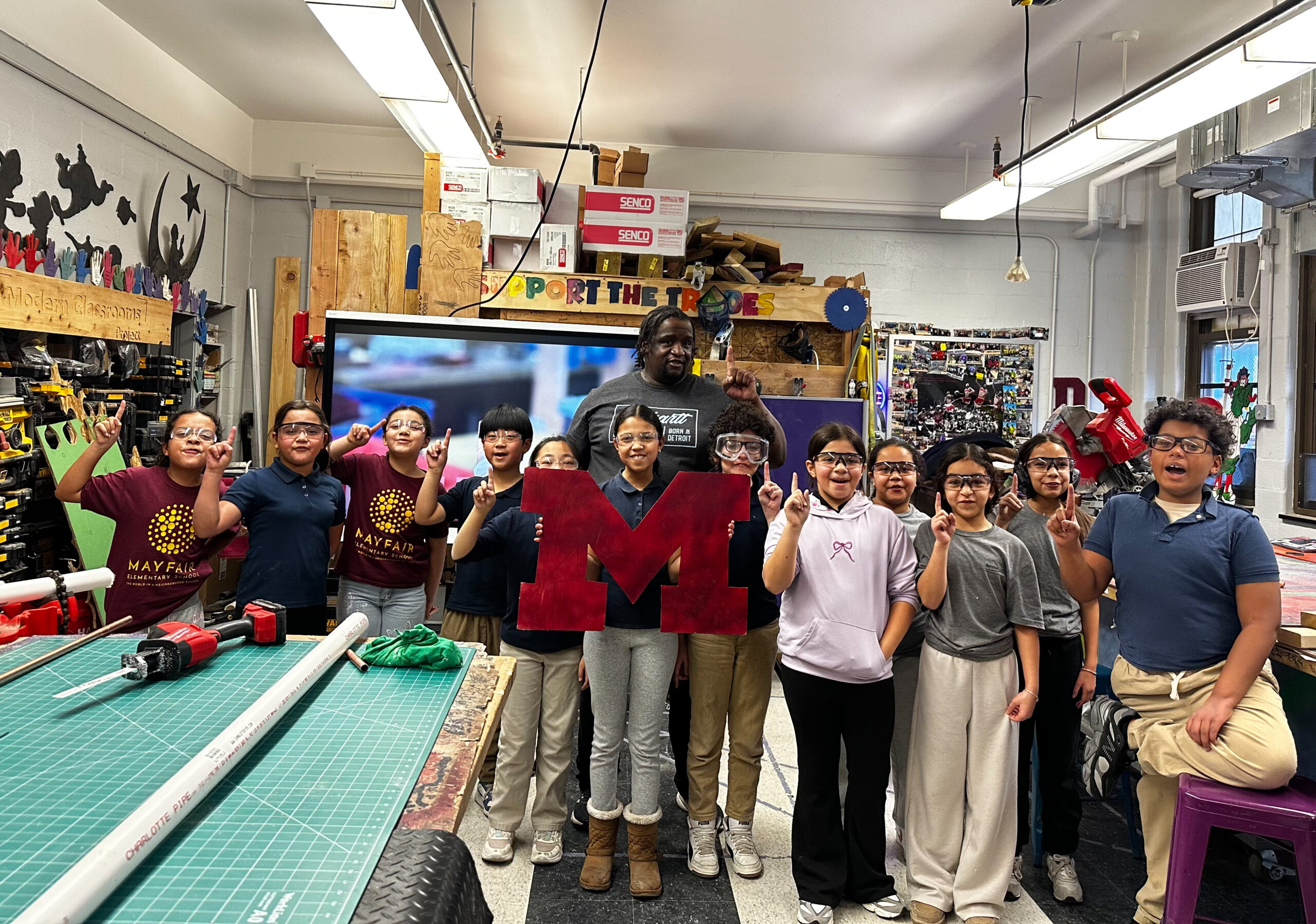
Students weren’t sitting – they were moving, talking, and working with tools. Music played loudly over the hum of activity.
This was a Career and Technical Education class, or CTE in school language. For Jamiah, nothing about it felt academic, and she wasn’t interested in figuring it out.
“I’m supposed to be in your class,” she told him. “I’m not coming.”
Jarrett didn’t chase her down the hallway or try to win her over with a speech about opportunity or potential. He opened his gradebook and filled her column with zeros … including for assignments they hadn’t even done yet.
The next day, she came back to ask a question.
“Why you put all those zeros under my name?”
“Because you supposed to be here,” Jarret responded.
She transferred out anyway.
At least, that was the plan.
Why She Came Back
But something about the class stayed with Jamiah.
In the hallway, students talked about what they were building. On phones, video clips circulated among students, showing projects, progress, names attached to work, and praise attached to effort.
There was a kind of recognition happening in that room that didn’t exist everywhere else.
And then came a quieter realization – that she might be missing something.
When her schedule brought her back the next quarter, she walked in differently. Still guarded and still skeptical. But paying attention.
That was enough for Mr. Jarrett.
“I saw the potential was there,” he says. “She just wasn’t using it correctly.”
The change didn’t come all at once. It rarely does. It came through repetition, expectation, and small wins that built into something larger.


Now Jamiah is an honor student at a career and technical education high school, studying plumbing. She speaks at conferences.
On weekends, she teaches alongside the same teacher she once avoided. Recently, she traveled with Jarrett and her mother to Denver, Colorado, to talk about how middle school exposure to the trades changed her path.
“There’s a lot of stories,” Jarrett says. “That’s just one.”
You Hear the Classroom Before You See It
The hallway gives it away first.
Music spills out before the door opens. It’s not background noise, but something louder and deliberate, competing with the sound of tools. Voices overlap, but there’s direction underneath it all.
Inside, the room feels alive.


Students move with purpose. Safety glasses on. Materials in hand. A fourth grader lines up a cut on a miter saw. Nearby, another student works a copper pipe, learning where precision matters and where it doesn’t.
“This is not your normal classroom,” Jarrett says.
Instruction happens in motion. A piece of wood gets checked, handed back, corrected.
“Do it again.”
No lecture. No frustration. Just expectation.
The energy has earned him a nickname that carries weight among kids – The Dope Teacher.
It started years ago when he was teaching high school. A student made a sign, half joke and half recognition, and brought it into class.
“It said ‘The Dope Teacher,’” Jarrett says. “I still got it to this day.”

It was a reflection of how students experienced him. He was different, direct, and someone who met them where they were.
“They gave me the name,” he smiles. “And it stuck.”
The door rarely stays closed for The Dope Teacher’s classroom. Students assigned elsewhere somehow find their way in too.
“They’re constantly knocking at my door, trying to sneak into my classroom,” Jarrett says. They’re allowed in.
“If they make it around here, they coming in. I’m never going to deny anybody a chance to learn something new.”
Other classrooms are measured by quiet. By stillness. By control. Here, engagement replaces all three.
It doesn’t feel like school. It feels chosen.
Where Confidence Changes Everything
In most classrooms, the same students lead.
The ones who raise their hands first. The ones who already know the answer. The ones who have figured out how school works and how to succeed inside it.
Everyone else is forced to adjust around that.
In Jarrett’s class, that dynamic shifts.
“The kid that’s usually struggling on the other side… they come over here and become confident,” he says.
The difference isn’t subtle. It shows up in posture first. In how a student walks into the room, how long they hesitate before trying something new, how quickly they look to someone else for confirmation.
Then it starts to move.

Students who rarely get recognized in other classrooms become the ones explaining things in CTE class. Measuring, cutting, correcting, and showing someone else how to do it.
The roles flip.
The student who struggles with reading might be the one leading a lesson on pipe fitting. The student who excels academically might be the one asking for help figuring out a measurement.
It balances itself out. For some of them, it’s the first time they’ve felt what that looks like.
The First Positive Phone Call Home
The shift doesn’t stop in the room. It follows them home.
At some point, the phone rings, or a message from Mr. Jarrett comes through to a parent. Not a warning. Not a report of something gone wrong. Something else entirely.
“I never call with anything negative first,” he says.
Instead, it’s a moment captured – usually a short video, a photo, something built, something finished, something done right.


“A lot of times I’m the first teacher to ever call saying something positive about their kid,” Jarrett shares.
On the other end, there’s usually a pause. The kind that comes when someone is trying to process what they’re hearing, because it doesn’t match the pattern they’ve come to expect.
Then the tone shifts. Pride replaces concern. Surprise gives way to something steadier – because for many families, it’s the first time school has called with good news.
For the student, it lands even deeper.
“They don’t want to mess up in my class,” Jarrett says. “Because they see the praise that they’re getting.”
That reaction doesn’t come from a rule or a consequence written on a board. It builds quietly, through repetition, through being seen, through being recognized, through hearing something positive said out loud.
Confidence starts to look like recognition. Recognition begins to carry expectation. And expectation, over time, shapes behavior.
Because now there’s something real and earned – something worth holding onto.
Before the Classroom, There Was the Job Site
Long before the classroom, there were job sites.
The kind spread across Northwest Philadelphia – row homes in need of repair, basements half-finished, ladders leaning against brick that had been standing for decades.


It was work that didn’t announce itself but was always there. Something to fix. Something to rebuild. Something that needed to hold up when it was done.
That’s where Evin Jarrett spent nearly twenty years.
He learned the trade by doing it. Taking on jobs, managing projects, figuring out how to deliver work people could depend on. If he did a great job, he got paid, and he got referrals.
There was never a shortage of opportunity during those years, though it was difficult to find consistent help.
“Good help was always hard to find,” Jarrett says. “I was getting the jobs but didn’t have enough people to do them.”
The work kept coming. Enough to grow. Enough to scale. But without the right people, growth wasn’t always possible.
“So instead of scaling it forward … I had to scale it back.”
Occasionally, there were random volunteers. Someone walking past a job site would notice he was short-handed, and throw out a quick question: “You need help?”
Sometimes Jarrett said yes.
They’d step in, unsure at first -picking up tools, watching closely, trying to figure it out as they went. “I would teach them the trade,” he says. “And I saw there was real interest.”
It wasn’t a formal system. It didn’t need to be. What mattered was what happened next.
Give someone the chance to build something real, something they can see and point to – and a shift happens fast. Focus sharpens. Confidence starts to take shape.
That part stayed with him.
The Day Everything Changed
Jarrett’s path into the classroom didn’t start with a plan.
It started with a fall. A bad one.
An injury on the job changed what his body could handle. Then came the surgeries – a shoulder, a knee – the kind that don’t just slow you down, but force everything to stop. The version of his life he had built no longer worked the same way.
“I was trying to rediscover myself, reinvent myself,” he says.
What came next wasn’t something he had been working toward or part of a calculated pivot. It was simply what was available.
A job inside a school. Building engineer. Maintenance. Keeping things running – fixing what needed attention, and making sure the space held together.
It could have ended there. But then students started showing up.
Not by choice.
Students who had gotten into trouble were pulled from the classroom and placed into in-school suspension. They found themselves sitting with Mr. Jarrett.
The expectation was simple: sit still, stay quiet, wait it out. But that’s not what happened. Instead, Mr. Jarrett put them to work. And surprisingly, “They just loved it,” he says.
It started small. Fixing things. Cleaning things. Learning how to use tools they had never touched before.
Then something bigger happened.
“You didn’t see a lot of kids vandalizing … because they knew they had to fix it.”
The connection was immediate. When you’re responsible for something – when you’ve built it, repaired it, taken ownership of it – you treat it differently.
The same students who might have written on the walls were now the ones maintaining them.
The energy shifted.
And for Jarrett, something clicked.
“A bug just jumped at me,” he says. “I kept thinking to myself … I should really pursue this teaching thing.”
The tools hadn’t changed. The environment had. And from that point forward, so was the direction of his work.
What He Built Instead
What started in a maintenance room didn’t stay there. It grew.
Today, Jarrett runs one of the only middle school trades programs in the School District of Philadelphia, right inside Mayfair. Students as young as fourth grade step into a space that feels closer to a job site than a classroom.


The work begins long before they walk through the door.
“By 4:45 in the morning, I’m out of the house. By 5:15am, I’m inside the building, getting things ready for class,” Jarret explains.
There’s always something to reset. Tools to organize. Materials to prep. Space to get ready for what’s coming. By the time students arrive, everything is in place.
They don’t ease into it. They’re expected to work right from the start.
Carpentry. Plumbing. Electrical basics. Masonry. Even early exposure to solar installation.


Students measure, cut, connect, and correct. They learn the difference between getting something close and getting it right. They see what happens when something doesn’t line up, and what it takes to fix it.
The work is immediate, and so is the feedback.
“This is not your normal classroom,” Jarrett says.
It isn’t built around worksheets or screens. It’s built around doing – giving students something they can hold, something that proves they can do more than they thought.
Everyone adjusts.
Many of them leave with early credentials and real skills they can build on. There’s also a clearer sense of what’s possible and how to get there.
Because in a system that often waits until high school to introduce career pathways, this classroom starts earlier. Much earlier.
“We can no longer wait until 10th grade,” Jarrett says. “By then, too much has already been decided … what students believe they’re good at, what they avoid, and what they think is available to them.”
At Mayfair, that decision happens differently and sooner.
Mic Check
The work in Jarrett’s classroom is physical. But there’s another layer to it which is quieter, but just as important.
It starts with a table. A microphone. A few students leaning forward, not always sure what to ask at first, but willing to try.
“We do a podcast,” Jarret says. “Nine o’clock… whatever day I don’t have coverage. It’s called Dope Student Podcast.”


There’s no production team, no polished rollout, and no scripted questions handed out ahead of time. Just consistency and access.
Guests come through with stories—people in the trades, entrepreneurs, professionals who found their way into work that made sense for them, even if the path wasn’t straight.
“If I get five plumbers,” he says, “there’s five different stories about how they got into the trades.”
That’s the lesson. The path.
Students listen. Then they start asking questions.
How did you start? What did you mess up? Would you do it again?
At first, the questions come out hesitant. Then they don’t.
Something shifts when students realize they’re allowed to be curious, and not being tested, or graded.
The same students who might hesitate to speak in class begin to find their voice here. They learn how to listen. How to respond. How to carry a conversation.
More importantly, they learn how to see themselves in someone else’s story.
Because for many of them, that is what’s been missing. Not ambition. Exposure.
What the podcast does, quietly and repeatedly, is expand what feels possible.
What Happens After the Bell Rings
The impact doesn’t end when the class does. It shows up in what doesn’t happen.
The time that isn’t spent outside with the wrong crowd. The bad decisions that don’t get made. The situations that never materialize because something else is already taking their place.
“When the kids come to me… they too tired to run the streets,” Jarrett says.
The days start early and the work is physical. Focus isn’t optional. And by the time students leave, they’ve already put in hours most people their age haven’t experienced yet.
But it goes deeper than that.
Because once a student starts to feel good at something, really good, their priorities begin to shift. The idea of throwing that away doesn’t land the same way anymore.


“When the kids don’t have anything they feel like they can lose, they’ll do whatever,” Jarret says.
That’s the part most systems miss. The behavior isn’t the starting point. It’s the result.
Give someone something real, something they’ve earned, something they’re proud of – and the calculation changes.
They start protecting it.
And in a world where more and more traditional pathways are shifting, where automation is rewriting what work looks like, those options matter more than ever.
The work of building, fixing, installing – work that lives in the physical world – holds its ground.
Students may not say it that way, but they understand it.
They see what these skills can lead to. They see how quickly something learned in that room can turn into something real outside of it—into work, into income, into independence.
A different kind of future starts to take shape.
A Labor of Love
For Jarrett, doing anything other than teaching no longer seems fathomable. He loves all of it, especially the “aha” moments.
A student steps forward. Hesitates.
“Go ahead.”
The cut lands.
For a second, nothing.
Then it hits.
“Just the shock that you see on their face after that first cut,” Jarrett says. “It is priceless.”
I ask him to look 40 years ahead and tell me what he hopes his former students would say about him.
He pauses.
“They just smile,” he says. “I’m gonna leave it there.”