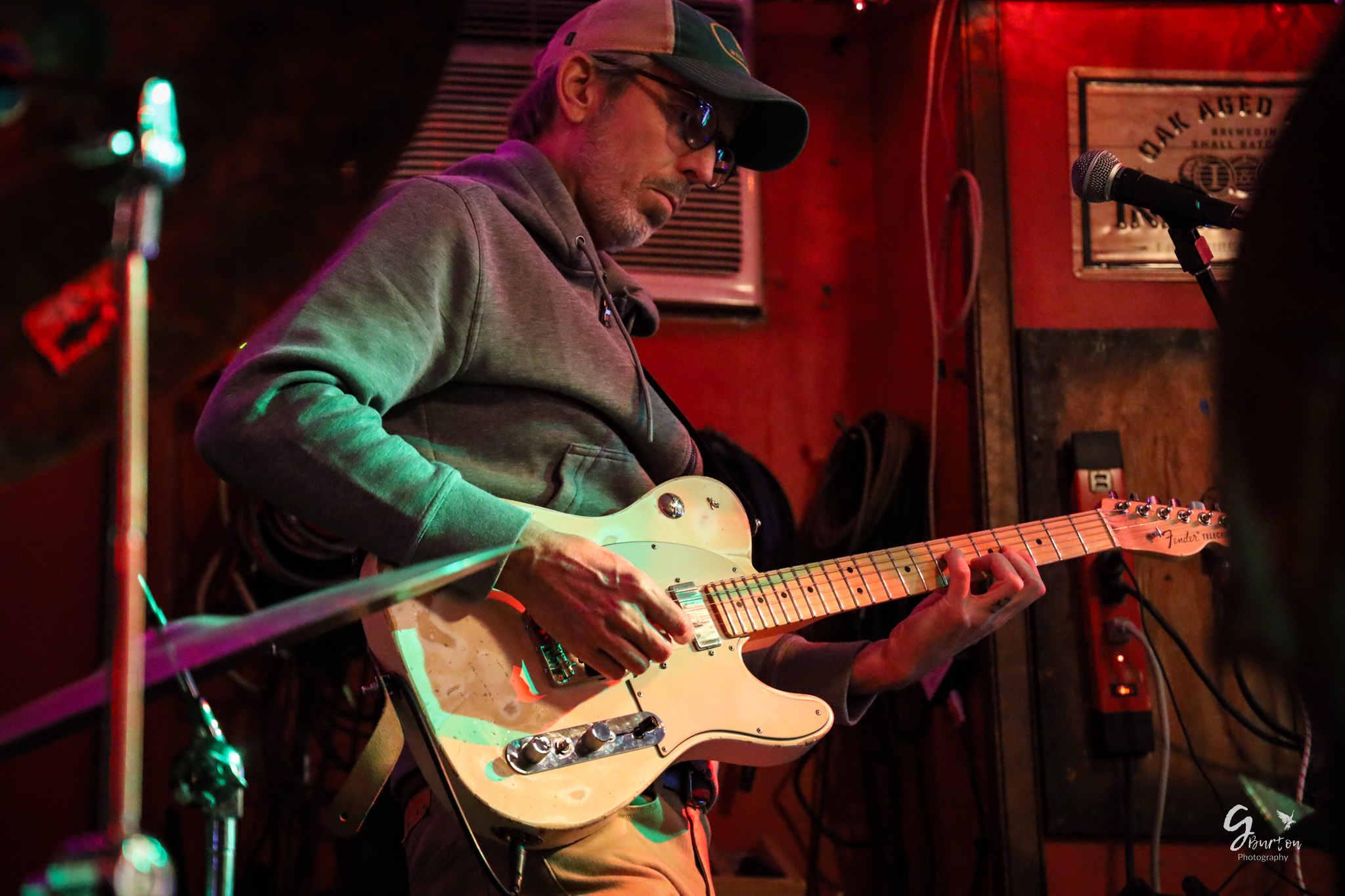

Erik Sayles can play the damn guitar. Don’t just take my word for it. There are witnesses.
Over the years, he has played with, recorded with, or shared rooms with people whose names eventually appeared on festival posters and Grammy broadcasts: Jill Scott. Musiq Soulchild. Bilal. Darius Rucker. Questlove. Randy Brecker. Macy Gray.
What makes this mildly confusing is that Erik Sayles has spent more than three decades as a professional musician while refusing to do almost everything musicians are told they must do to succeed.
He’s never chased a hit song.
He’s never branded himself.
He’s never asked strangers on the internet to smash a like button.
He’s never explained his music in a way that would make it easier to sell.
He’s never described himself as “on a journey.”
And yet somehow, stubbornly, almost inconveniently, Erik has built a real, sustained, respectable life in music.
He has been present at the quiet beginnings of careers that later became very loud – playing on records, backing famous singers, anchoring house bands, standing close enough to pivotal moments that, if you were feeling dishonest, you could frame as destiny.
They weren’t.
Because nothing about Erik Sayles’ early life points toward inevitability.
The Origin Story, Rejected
There are origin myths we’ve all heard about elite guitar players: the garage-band fireworks, the sainted uncle who teaches you “Blackbird,” the moment some older kid hands you a distortion pedal and your life becomes a fog machine.
Erik Sayles’ origin story dodges all of that. It begins, as many great artistic journeys do, with a poorly executed birthday gift.
“My mom wanted a nylon-string acoustic guitar,” Erik says. “My dad went off the rails and bought her a Fender Stratocaster and an amp.”
This is not a subtle difference. It’s like asking for a goldfish and being handed a live alligator with no instructions.
The Stratocaster went into a closet. Little Erik went into the closet too, periodically, to visit it.
He took it out, turned a few knobs, strummed open strings, and quickly discovered a universal truth: guitars are extremely boring when you don’t know what you’re doing.
“There’s only so long you can strum open chords before you’re like, alright, this is enough,” Erik says.
The guitar went back in the closet.
Then, years later, on a family vacation, a guitar appeared again … this one belonging to a friend of his mother’s.
Erik still couldn’t play it. He didn’t even make much noise with it. But something about it held his attention in a way nothing else had.
His mother noticed.
And, like most parents faced with a child’s vague but persistent interest, she tried to help by signing him up for guitar lessons … sort of.
Erik’s first formal guitar teacher was, technically speaking, not a guitar teacher at all.
“He was a clarinetist who ‘knew enough about guitar to teach it,’” Erik says, already smiling. “He had the loudest finger snap, like a whip. He’d count things off, and go, ‘No, no, no. Play it like this,’ and then pick up his clarinet.”
If you’re wondering how a child is supposed to translate clarinet phrasing into guitar technique, the answer is … poorly.
“It was weird. I didn’t do the homework,” Erik admits. Eventually, the teacher sat Erik and his mother down, clarinet in hand, and delivered the verdict.
“He’s not progressing.”
The lessons ended quietly. The guitar went away again. No vow was made. No dramatic promise followed. They simply stopped.
It was an unremarkable ending, but also an early indication of something that would quietly shape Erik’s life. When something didn’t fit, he didn’t argue with it or try to force it into place. He let it go and waited for the next thing that made sense.
The Accidental Elective
In high school, in rural Vermont, Erik Sayles was certain about exactly one thing: he was going to be a visual artist.
Drawing was the plan. Pencils. Paper. A reasonable amount of angst.
College, as he imagined it, would involve studios, critiques, and people using words like canvas, journey, and muse with a straight face.
Then the art class filled up. Erik was forced to choose something else.
“So, I took guitar,” he says. “It was the only open elective.”
There was no lightning bolt, no teacher leaning back in a chair and saying, ‘You really have something.’
The art class was full. Guitar was open. He needed a credit.
And then something unexpected happened: the work responded.
With guitar, effort produced sound. You played something and a song happened. Cause and effect. No translation required. School had often felt like decoding. Guitar felt like doing.
“I just wanted to learn songs,” he says. “That’s what resonated with me.”
Music theory, on the other hand, felt like instructions delivered in a language Erik didn’t speak.
“Here’s a scale, here’s how you use it,” he remembers. “But there was no context. If you don’t present that stuff in an edible way, it just goes right over your head.”
With guitar, the feedback was immediate. It either sounded good, or it didn’t.
His teacher tried. Erik tried, selectively. The report card comments were consistent: Not always prepared. Excels here. Not really into the academic part.
Outside class, he joined a band. The school was small enough that this was possible, and isolated enough that it felt necessary.
They called themselves The Restrictionists, named after the disciplinary system that limited students’ freedom when they screwed up.
“It was basically a polite FU to the administration,” Erik chuckles.
They played Police songs, Dire Straits, classic rock, whatever they could manage. There were two guitarists, no fixed hierarchy, solos traded casually. No grand ambitions. It worked.
Looking back, it’s tempting to dress this up as a turning point. It wasn’t.
Nothing flipped overnight. Guitar didn’t announce itself as a calling. It simply became the place where effort felt less like compliance and more like curiosity.
That difference mattered.
By the time graduation approached, Erik knew he wanted to keep playing.
Berklee and the Year of Dishes
So, Erik applied to the Berklee College of Music.
Not a music school. The music school.
Think of Berklee as the Olympic training center of music education. It’s a place populated almost entirely by people who were the best musician they had ever met, until they arrived and discovered thirty others who were better, while warming up.
Berklee doesn’t specialize in learning from scratch.
In the late 1980s, if you wanted to study music seriously, your options were narrow and judgmental.
You could study classical. You could study jazz. Or you could do something else and be looked down upon by both. There were no majors for “contemporary performance” or “figuring it out as you go.”
Erik chose jazz, because it felt closest to the world he already inhabited.
“I knew I didn’t have a lot of knowledge,” he says, “but I could play. I had facility.”
He prepared. He applied. He showed up convinced he would get in.
He had even sent compositions, pieces built from chords he discovered organically, stacking notes by ear. “They weren’t the normal shapes,” he says. “I just didn’t know what to call them.”
At the audition, Berklee never asked him to play.
“They just asked me a bunch of theory questions,” Erik says. “I failed pretty much all of them.”
At the end, one of the evaluators asked a final question. “‘Why do you want to come here?’” Erik responded with two words, “To learn.’”
This was, apparently, the wrong answer. His application was rejected.
“They made me feel incredibly small,” Erik says. “It was brutal. I had all my eggs in that basket.”
This is the part of the story where, in a different article, the rejection would become fuel. But that didn’t happen either.
Instead, Erik did something much less cinematic. He took a year off.
He moved to Burlington, Vermont, because friends from his high-school band were there. He washed dishes in a restaurant. He played when he could. He listened a lot.
What he didn’t do, was panic.
He let the rejection sit without turning it into a personality.
Eventually, restlessness won out over patience and Erik went west, enrolling in a one-year program at the Musicians Institute in Hollywood … a place that promised immersion, intensity, and a certificate at the end.
“It was crazy,” he says. “Late ’80s. End of the hair metal scene.”
It was useful. It was exhausting. It was also, not the end of the road.
The degree would come later. In a city he’d never been to. One that, unlike Berklee, was exactly the right size for the way Erik moved through music.
Philadelphia was waiting.
The City of Art Schools and Small Departments
Erik Sayles learned about the University of the Arts (UArts) the old-fashioned way, through an actual human being whose job involved guidance, not hyperlinks.
“There was no internet,” he laughs. “I didn’t know anything about Philadelphia. I knew of Philadelphia cream cheese. Maybe pretzels, cheesesteaks, and the Hooters.”
He applied as a jazz performance major largely because, at the time, jazz was the most contemporary option available that still came with institutional approval.
If Berklee had been the Olympic trials, UArts felt more like a working rehearsal space.
And then something Berklee could never offer him happened: art school.
“It was incredible,” Erik says. “Dancers. Theater people. Visual artists. Just creative people everywhere.”
That mattered more than it sounds. In addition to music, UArts was a building full of people trying to create things, failing publicly, trying again, and doing it alongside one another.
For someone uninterested in being the headline, this was exactly the right environment.
The music department itself was small. There were more guitarists in Erik’s freshman class than in the rest of the program combined.
The upside was immediate: if you could play, you played.
“Being a performance major meant you were put into situations whether you liked it or not,” Erik says. “You were in ensembles. You had to get on stage.”
By his sophomore year, he earned a spot in the Fusion Ensemble and stayed there through graduation. The director encouraged original compositions, which gave Erik permission to lean into something he’d already been doing instinctively.
“Had I gone to Berklee,” Erik says, “I would’ve been buried by the numbers.” At UArts, he could get into rooms. He could play. He could write, fail, adjust, and try again the next week.
For the first time, Erik wasn’t being evaluated primarily on what he lacked. He was being judged on what happened when he played.
The Tape You Mailed and Forgot About
During his years at UArts, Erik did make a serious run at the next logical step.
He formed a band with classmates, wrote most of the material himself, and began mailing demos to record labels … literally copying addresses off the backs of CDs and cassettes.
“This was pre-internet,” he says. “You’d just send tapes out unsolicited and hope something happened.”
Mostly, nothing did.
Then a coincidence landed. The band’s saxophonist, Chris Farr, had a childhood connection to a small South Jersey label that was changing direction. The timing was right. The tapes landed on a receptive desk.
“They liked the music,” Erik says. “And it basically came down to just Chris and me signing with the label.”
Erik wrote the majority of the record. To give an unknown project weight, the label spent its modest budget bringing in players Erik had grown up admiring, including drummer Dennis Chambers and trumpet legend Randy Brecker.

“These guys were famous jazz musicians at the time,” he says. “They listened to the material and were into it enough to be part of it.
Two records followed in the mid-1990s, and because of the notoriety of the legendary players, received critical acclaim. “They were reviewed in Jazz Times, Downbeat, and a number of other publications,” Erik recalls.
“I never saw any money from those records though,” Erik says, without bitterness. “The label put a lot into it. That was that.”
The project faded the way many early collaborations do, as everyone involved grew into different lives.
Erik came away with clarity.
He had seen the machinery up close: the spending, the names, the reviews, the noise surrounding the work … and how little any of it mattered once the room emptied.
The lesson didn’t demand reinvention.
New York by Way of Philly
After graduation, New York arrived in Erik Sayles’ life through someone else’s phone call.
A drummer from New York began commuting to Philadelphia to teach at UArts. He heard Erik play and said, “I’m going to call you to play in my band,” Erik recalls. And then, without ceremony, he did.
What followed was a working musician’s education, mostly at night.
There were residencies at jazz clubs that no longer exist. A week at Sweet Basil. A few festivals. A loose triangle of gigs connecting Philadelphia, New York, and Maryland … enough motion to keep the chops sharp and the rent paid – sometimes barely.

When music fell short, Erik filled the gaps the traditional way: teaching, painting houses, wedding bands, whatever kept things moving.
This was also when Erik became what musicians secretly value most: useful, reliable, easy to have in the room.
Philadelphia’s scene at the time was small, porous, and efficient.
Through that network, Erik found himself pulled into DJ Jazzy Jeff’s Touch of Jazz orbit, a loose, industrious ecosystem of producers, musicians, and studios where people worked constantly.
“That’s how I got on Jill Scott’s first record,” he says. “That’s how I got on Darius Ruckers’ first R&B record after Hootie & the Blowfish. That’s how I got on other people’s records that aren’t household names.”
If Touch of Jazz taught Erik how to function inside a studio, Wilhelmina’s taught him why any of it mattered.
Every Thursday night in the late 1990s, Wilhelmina’s (an unassuming space on 11th Street) became something else entirely. At the time, nobody thought of it as music history; it was just where people went to see what might happen.
Erik was part of the house band, backing whatever happened next on stage. The first set belonged to the band. After that, the room took over.
“It was basically an open mic,” he says. “But not in the way people think of open mics.”
The band would set up a groove and let it breathe. Singers, poets, rappers would then step up. Nothing was planned or explained. The music never stopped, it just shifted.
“There are nights I still get chills thinking about,” Erik says. “One night in particular… Jill, Bilal, Musiq—one after the other. They’d finish, hand the mic off, and we’d just move somewhere else musically.”
“It was totally organic. Things happened in the moment. It was like catching lightning in a bottle,” he emphasizes. “We knew something special was happening in that moment.”
Nothing was recorded.
Those nights became formative not because of who was there, though history would eventually underline those names, but because of what the music demanded: attention, flexibility, humility, trust. You listened. You responded.
It was, in many ways, the purest version of the work.
There were moments when Erik’s world threatened to expand. When the Wilhelmina’s pipeline fed directly into Jill Scott’s touring operation, Erik was asked whether he’d be interested.
The offer arrived alongside reality. His wife had a demanding corporate job. They had a young child, with another on the way. Touring meant leaving something solid for something hypothetical.
“I would’ve liked to,” he says. “I just couldn’t break away. It wasn’t the move at the time.”
This is where a different kind of story would linger on the word almost.
Almost toured.
Almost broke out.
Almost left.
Erik doesn’t use that word.
Instead, he stayed in Philadelphia, and in rooms where he was useful. And before long, he took the most unromantic, permanent step a working musician can take.
He signed a lease.
The Workshop Years
In 1998, Erik did something that almost no working musician dreams about as a career move … he opened a music school.
He opened the Music Workshop in Manayunk – a steep riverside neighborhood close enough to Philadelphia to count, and far enough uphill to feel like its own small town.
“We taught everything,” Erik says. “Guitar, bass, drums, keys, winds. Kids to adults. All levels.”
Most of the students were elementary and middle-schoolers, which meant the job had less to do with music than verbs.
You book. You fix. You schedule. You remind. You encourage. You unclog toilets. You print recital programs five minutes before parents arrive and pretend this was always the plan.
Between lessons and performances, Erik learned the economics of geography. New schools opened closer to where families lived.
“Why would someone drive to Manayunk from Plymouth Meeting or the Main Line, if there’s a place ten minutes away?” he remembers thinking.
So, he adapted, adding another location and a performance annex in Berwyn, trying to keep access close and convenient.
His own playing shifted into the margins, the way personal pursuits often do when rent, payroll, and reality enter the room.
What the Music Workshop became, slowly, was something Erik never set out to build: a place where music fit into real life instead of standing apart from it.
Kids came after school. Adults came after work. Parents sat in folding chairs at recitals.
“I didn’t always realize the impact while I was in it,” Erik says. “You’re just trying to keep everything running.”
The realization came later, in fragments. A parent stopping him after a recital with kind words. An adult student thanking him for a weekly hour that felt like oxygen.
“They’d say, ‘This changed my kid’s life,’” he says. “And I’d think, that’s the teacher. But I get it. We built the room that made it possible.”
He lights up when he talks about the long view. A student who started at four and just graduated college as a guitar performance major. Another who returned years later as a voice teacher.
“Seeing people find a musical path, and knowing you had a role in that … that’s the stuff,” he beams.
Erik didn’t stop playing during those years. He just played differently. At night, between obligations.
And eventually, when the Workshop years loosened their grip, Erik began to hear his own music asking for space again.
Making Room Again
Around 2011, Erik began rebalancing his life in music. Less wedding-band grind. More original projects.

There was a trio including a short-lived but memorable experiment called Guitar Army; three guitars, a rhythm section, and no interest in explaining itself.
He also returned to his alma mater, in a different capacity.
In 2014, he joined the faculty at University of the Arts, teaching private guitar lessons to jazz performance majors and running a blues ensemble.
Teaching at the college level surprised him.
“It’s fun,” Erik says. “You get 20-year-olds who are playing well beyond their years.”
He credits the internet. “It changed everything. There are just great young players everywhere now. They learn a lot online.”
What Erik was able to offer them was something harder to Google: how to listen, how to feel time, how to function inside a room without turning yourself into the point.
Two Records, Two Ways of Listening
In recent years, another hyphen quietly joined Erik’s résumé … producer/mixer. Home recording had finally found it’s way to his door.
“I had a lot of ideas sitting in my Logic folder,” he says. “Half-finished things that I decided I needed to actually finish.”


Erik turned those ideas into two record releases in 2025.
The first, Live at the Sanctuary, documents a fully improvised trio performance with bassist Tone Whitfield and drummer Lionel Forrester.
“Three people who had never played together,” Erik says, “but I’d played with each of them individually.”
“We didn’t go in planning to make a record,” Erik says. “We decided to record and film the session just in case. And it came out well enough that we all thought it was worth releasing.”
The second project called Melange goes in the opposite direction … intensely produced, sonically layered, seventeen tracks with only two guitar solos.
Asked if he would do performances related to the release, he laughs. “I can’t replicate it without the use of my computer. There’s a lot of sonic elements, and that would be hard to replicate live in real time. It’s just too cumbersome.”
“Mixing is subjective,” he says. “There is no single right answer. Just personal taste, applied consistently.”
He admits he’s not built for the current expectation that every artist double as a social media content creator.
“You kind of have to be like, ‘Hey, look at me over here,’” he says. “I’m not very good at selling myself. But I enjoy making the music.”
Ask Erik about the best moments of his musical life and he won’t point to a stage or a name. He talks instead about a feeling.
“There are moments where you’re fully present,” he explains. “You’re hyper-focused on what you’re doing and at the same time what everyone else is doing. Somebody hears something and reacts, and the whole thing shifts. You look up, and everybody knows it’s happening and you just smile at each other.”
That’s why you do it.
From the outside, his life might look modest. He didn’t chase fame. He didn’t build a brand. He opened a school. He taught. He played regularly. He made records that resist easy categories.
Near the end of our conversation, I ask what he wants people to know about his music.
“They don’t have to know anything,” he says. “It’s there. If they get something out of it, great. If not, that’s okay too.”
Then he adds with proud subtlety, “I’m really happy with both records. Live at the Sanctuary captures a special moment in time. The solo record, Melange, is eclectic and not for everybody. Ultimately, it’s for me, as all art should be for the creator. If others like it, that’s a great by-product.”
He’s practicing more now. Playing more. Finishing a third record he tracked years ago and shelved until his skills caught up with his standards.
Erik Sayles never did become the point.
The music did.