By mile 23 of the Boston Marathon, Stephanie Young was hiding in a porta potty.
Outside, a nor’easter was throwing freezing rain sideways across the course. The wind was brutal, the streets were soaked, and her body was shaking so hard she could barely dial her phone.
Inside, though, it was dry.
“I remember I was in the porta potty, and it was the only place I could find where I wasn’t getting rained on. I didn’t want to leave. You know it’s really bad when you don’t want to leave a porta potty,” she laughs.
Somewhere between Hopkinton and Boylston Street, you forget that Stephanie didn’t grow up thinking of herself as an athlete. Or that she didn’t run any race at all until she was over 40 years old.
You also forget that she’s 4’10”, about 98 pounds … a woman who still insists, “I was never an athlete growing up. I was a very slow runner, until I pushed myself out of my comfort zone.”
But that’s the thing about Stephanie Young: if you give her just enough time and a goal that sounds slightly unreasonable, she will quietly rearrange her life until it becomes normal.
Today, she’s run 24 marathons and 3 ultra marathons, completed all six of the World Marathon Majors, and is now chasing a half Ironman — despite the small technicality that she, in her own words, “can’t really swim.”
And it all started in Philadelphia … with a race she couldn’t quite imagine finishing.
The 10-Mile Cry Fest That Started It All
Stephanie’s first real brush with distance running came with a classic Philly rite of passage: the Broad Street Run, a 10-mile dash straight down the spine of the city.
If you’ve ever run it, you know the scene. A roaring river of thousands of runners flooding Broad Street, the city’s main north-south artery, cheered on by strangers with cowbells, coffee, and soft pretzels.
It’s the largest 10-mile race in the country, a fast, mostly downhill course that ends dramatically inside the Navy Yard. Pure Philadelphia, from start to finish.
“I didn’t even run a race until I was over 40,” Stephanie says.
For years she thought about maybe trying Broad Street but couldn’t find anyone else willing to sign up for the ten miles of early-morning insanity.
Then, while working as a counselor at a school, she met a teacher who led a small running club. “I asked if she’d do it with me,” Stephanie recalls. “She said yes, and that was all I needed.”
There was just one problem. Neither had a clue how to train.
“We started out meeting every Sunday on the tow path in Bucks County, and we would just run 15 minutes out and then back,” she says. “The next week, we’d run 20 minutes out and back … and gradually increase our distance each week.”
It wasn’t fancy. It wasn’t scientific. It was consistent.
On race day, it took them about an hour and 40 minutes to finish the Broad Street race. For Stephanie, she couldn’t have cared less about the finishing time.

The moment she crossed that finish line was life-changing for her. “I remember I was so happy I cried,” she says. “I was super emotional because I never thought I could run 10 miles straight.”
The next year they decided to do it again, adding another teacher to their little crew. After successfully completing the race, Stephanie casually suggested, “Do you want to do a half marathon? It’s only three more miles.”
That’s how it started: “only three more miles.” Famous last words in the running world.
Broad Street in the spring, a half marathon in the fall, long runs on the tow path from Washington Crossing to New Hope — that became the new normal.
“We went at a leisurely pace,” she says. “We weren’t racing. We were just trying to build our endurance.”
Still, a marathon-sized idea was beginning to take shape.
Anybody Can Train to Do This
“Running a full marathon had been on my bucket list forever,” Stephanie admits. “But it always felt like something other people did … not me.”
Then came the boot camp gym in Bristol PA. And with it, a woman who had done something that, to Stephanie, sounded almost mythical … the Philadelphia Marathon.
“I remember I was so impressed meeting someone who actually completed it,” Stephanie says. “I told her how I always wanted to run a marathon but thought it was beyond my reach. Well, she convinced me that I could.”
The message was simple: “She told me that anybody could do it. She literally looked me in the eye and said ‘I’m serious, anybody can train to do this.’”
That word … train … changed everything.
Her friend invited Stephanie to run the Disney Marathon as her first full. “She said it would be a good first marathon, because there’s so much to look at in the Disney parks,” Stephanie laughs.
They trained using a run–walk plan … seven minutes running, one minute walking … which sounds simple until you realize it adds up to a lot of minutes.
Two short runs during the week kept Stephanie honest, while the Sunday long runs stretched farther each time, until 23 miles somehow became a normal thing to do before lunch.
The first time she ran past the half-marathon mark, Stephanie didn’t feel victorious, just vaguely betrayed by her own curiosity.
“How long did that take?” I ask.
“A loooong [expletive] time,” she grins. “Basically, my whole Sunday.”
Stephanie laughs when she thinks back on those endless Sunday runs. “It was really slow,” she says. “But it was exciting to finally pass that 13-mile mark.”
Exciting enough, apparently, to sign up for a race that doubled the distance.
Disney Magic and a 70-Year-Old Game-Changer
The Disney Marathon, as it turns out, was less race and more fever dream; 26.2 miles through the Magic Kingdom, complete with princesses, humidity, and questionable life choices.
“You run through the four parks, and then you run through some behind-the-scenes areas too,” she says. “People will hop out of the race to ride on a roller coaster and then come back in the race.”
Stephanie did not get on any rides mid-marathon. Her friends, however, had different priorities.
“There were a lot of Disney characters along the route,” she says. “The friends I was with wanted to stop and take selfies with all of them. I told them I was going to go ahead and see them at the finish line.”


Her first marathon clocked in at 5 hours and 32 minutes,though to be fair, the weather and her travel companions were equally to blame. The Florida humidity wrapped around them like a wet towel, and her friends treated every mile as a photo op.
And yet, her favorite part came after the race, at a ridiculously expensive breakfast her friend had signed them up for.
She got there early … she’d finished 45 minutes ahead of her friends … and struck up a conversation with an older woman at her table.
“She had to be in her mid-70s,” Stephanie remembers. “She told me she started running marathons in her late 50s and had run three marathons a year since then.”
“I was 48 at the time and always thought running a marathon was going to be a one-and-done thing for me,” she says. “But I just felt really inspired by her.”
That conversation did something no long run ever could … it got into her head. “It made me think, maybe I’ll do this again,” she says.
Because who doesn’t finish a 26-mile sweat fest and immediately think, let’s do that again, … but harder, colder, and with fewer cartoon characters.
From “I’m Not Even an Athlete” to Almost Boston
If Disney was about survival, New York City was about possibility. She entered the lottery for the New York City Marathon (notoriously hard to get into) on a whim.
“I got in on my first try,” she smiles.
This time around, she picked a more serious training plan. She also found a reliable training partner through a friend of a friend.
“The first plan was just a plan to finish a marathon, but the training plan I did this time was a beginner marathon training plan, which my training partner shared with me. It was structured and really helpful.”
And in the middle of this, she started coaching Girls on the Run at her school, a program that combines social–emotional lessons with running for 3rd–5th grade girls.


“I had some girls that were really good athletes,” Stephanie says. “They were lacrosse players, and they were fast. I, however, was never one to push myself when I was running. I always stayed in my comfort zone.”
One day, that changed.
“I started thinking, let me see if I can catch up with Charlotte, and I would push myself. Then I’d try to catch up with Julie. I was like, wow, I can run faster than I thought I could.”
By the time she reached Staten Island for her first New York City Marathon in 2016, she’d learned to live closer to that edge of discomfort.
Stephanie started way in the back.
“I ended up in the last wave, one of the last corrals, because I had put in my Disney time of 5:32 which was categorized as a ‘very slow’ runner.” She spent 26.2 miles weaving through other runners through NYC’s 5 boroughs.
Her goal was to break five hours. She finished in 4:08. Nearly an hour faster than Disney.


“I remember thinking, this is the best day of my life,” she says. “The city was electric. I could’ve run another mile just to stay in it.”
She high-fived strangers, hugged family, and even crashed a charity tent by accident making new friends there too.
Then came the offhand comment from a friend, “If you shave fifteen minutes off that, you could qualify for Boston.”
Stephanie laughed so hard she almost choked on her post-race bagel. “Me? I’m not even an athlete. That’s crazy,” she remembers thinking.
But later, when the adrenaline faded and the city quieted, that sentence stuck around … like a song she couldn’t get out of her head.
Learning to Train Like a Runner
Friends encouraged Stephani to find a real coach.
She reached out to a serious runner she knew through a close friend. “I told him that I wanted to try to qualify for Boston,” she says. “He laughed for a while. But he didn’t say no.”
The he in question was a serious runner married to one of her close friends, the kind of guy who eats tempo runs for breakfast.
He agreed to coach her on one condition – she’d teach his sons a few cross-training moves in exchange for a crash course in marathon science.
“So I showed them some core exercises,” she says, “and he explained how to actually train properly for the Boston Marathon.”
For the first time, someone decoded the secret language of running plans.
“Before, my running plan would just say, ‘Run eight miles,’” she explains. “But when you’re training seriously, every run has a purpose. There are hill workouts, speed intervals, tempo runs … even your long run has a specific pace. I had no idea.”
The qualifying time for Stephanie’s age group was 3:55. She had just run 4:08.
Together, they reverse-engineered a goal: run a 3:50 marathon. That meant calculated splits, precise pacing, and a lot of lonely miles.
“I mostly trained by myself,” she says. “Running has kind of always been my therapy. If I have a problem, it’s a good time to sort through it. If I’m anxious or upset, it’s a good time to process my feelings.”

Apparently, it was also a good time to start plotting her next act.
To chase Boston, Stephanie picked a race known more for speed than spectacle, the New Jersey Marathon, a flat stretch along the Jersey Shore.
“It starts in Long Branch and ends in Asbury Park,” she says. “Very different from New York City. New York has a million spectators. New Jersey was quiet. I was glad I brought my AirPods.”
Her kids , on the other hand, were not quite as zen. “I trained really hard for that race,” she laughs. “After I finished, my kids were like, ‘Thank God that’s over. You were always so tired and cranky.’”
The crankiness paid off.
Stephanie crossed the line in 3:41, meeting the Boston qualifying standard. She actually demolished it by more than ten minutes.
“I finished third in my age group, for 45 to 50 year olds,” she says, still glowing at the memory. “I felt awesome after that race. I’ve struggled with confidence for most of my life, and running gave me confidence … that I can do hard things.”
Boston, Hypothermia, and a Stranger’s Kindness
For marathoners, Boston is a pilgrimage. The oldest marathon in the country, it’s the holy grail of distance running; invitation by qualification only.
“I feel like it’s every marathon runner’s goal to get to Boston at some point,” Stephanie says. “It’s very prestigious. It was a goal I didn’t think I could ever accomplish.”


By 2018, she’d earned her spot on that historic starting line in Hopkinton. The dream was real. The weather, unfortunately, promptly tried to kill her.
A nor’easter rolled in with perfect comedic timing.
“It was raining the whole time,” she says. “It was like 38 degrees and pouring rain. It was the most miserable experience of my life.”
The elites dropped out. The spectators huddled under ponchos. Stephanie ran … drenched, freezing, stubborn.
She crossed the line in 4:01, a time most runners would brag about on a sunny day. But what she remembers most came after the finish.
At the finish, she was shaking uncontrollably, on the edge of hypothermia, barely able to use her phone. She got funneled into a building with other finishers.
“I’m just standing there, shivering,” she says. “And this woman came up to me and asked, ‘Do you have dry clothes to change into?’ I said no. She said, ‘Are you okay?’ I said no. And she said, ‘Let me help you.’”
The stranger and a friend, got Stephanie into an Uber, made sure she got back to her hotel safely, and basically played the role of a medical tent Stephanie hadn’t known to look for at the event.
They’ve stayed in touch on Facebook ever since.
“My favorite thing about running marathons is really the people that I meet,” Stephanie says. “I always meet such cool, interesting people at every race. “
Boston, as it turned out, gave her proof that kindness can sprint in from anywhere, sometimes when you’re too cold to even ask for it.
Running the World (Literally)
Somewhere between Boston’s freezing rain and a half marathon in the Bahamas, Stephanie found her next mountain … or, rather, six of them.
“I met this woman in the Bahamas who had run all the World Major Marathons,” she says. “I didn’t even know world majors were a thing.”
The woman explained that there are six: New York City, Boston, Chicago, London, Berlin, and Tokyo; the marathoning equivalent of the Grand Slam.
“When I met her, I had already done New York and was getting ready to do Boston,” Stephanie says. “I thought, wow, I’ve already done one, I’m about to do two. I just might be able to do this!”
That thought turned into a mission – part bucket list, part global scavenger hunt.
She knocked off Chicago in 2018. Berlin came next, courtesy of the lottery gods. Then London called (twice) inviting Stephanie to run as part of the Wanda World Age Group Championships, an elite ranking that handpicks the fastest runners in each age category.
“I don’t even know how I got invited,” she laughs. “But London is really hard to get into, so I was super excited.”
Traveling the world sounds glamorous, until you remember she’s a full-time school counselor with three personal days a year.
“When I ran London, I used my three personal days,” she says. “I took off Thursday, Friday, and Monday. So, it was a quick trip. My daughter came with me, which was fun.”
Berlin’s timing was a small miracle. It overlapped with the Jewish holidays, giving her two extra school days. She pieced together the rest — a personal day here, a day without pay there — and still found time to celebrate with a beer stein in hand at Oktoberfest.

“Oktoberfest reminded me of being at a fraternity party,” she laughs, “but with people of all ages.”
From Munich, she hopped a flight to London to do it all again … because, why not?
Then came Tokyo, March 2025 — her first time in Asia, and the final jewel in her six-city crown.
“I loved it so much,” she says. Tokyo was everything she didn’t know she needed; the discipline, the beauty, the precision of it all.
“Everything was so organized and calm,” she says. “Even the spectators seemed polite.” After years of crowded corrals and chaotic weather, it felt like running inside a painting.
She spent three and a half weeks abroad, half in Japan, half in Thailand, making the most of a professional sabbatical she’d applied for “kind of on the down low.”


By then, Stephanie had run 23 marathons and 3 ultras (races over 30 miles long). And somewhere between the start lines and finish medals, she earned something few runners ever hold: the coveted Abbott Six Star Medal — a round emblem etched with the six cities she conquered.

The Ultra Marathon That Broke Her Heart
For all the medals, milestones, and finish-line euphoria, there’s one race that still catches in Stephanie’s throat … a 50-mile ultra marathon through the rust-red canyons of Arizona.
“It was amazing,” she says, “Until mile 40.”
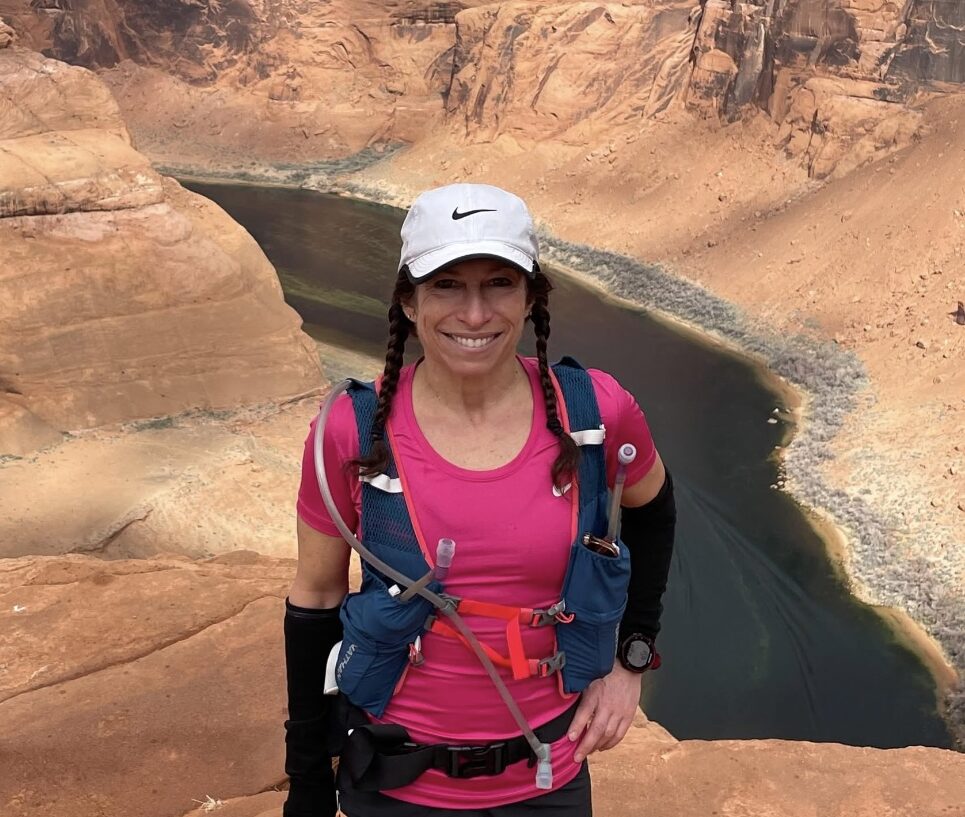
The Antelope Canyon Ultra starts like something out of a travel magazine: sand-swept trails, sunlight bouncing off slot walls, runners carving through the desert like moving brushstrokes.


But ultras have a way of reminding you who’s in charge, and it’s never you.
“It started raining around mile 30, and the hypothermia set in around mile 40,” she says.
“The dirt out there gets really slippery when it’s wet, so you can’t move fast. It was getting dark and windy and cold, and I was soaking wet. I was just shaking uncontrollably.”
“My friend, who I’d met in London, ran this race with me. He was like, ‘You’re gonna end up in the hospital. You have to stop.’ So, I stopped at mile 43. And it crushed my soul, because I knew I could have finished. I had trained so hard for it.”
The desert didn’t care how hard she’d worked. It just swallowed her effort in mud and rain. And that, more than the cold or exhaustion, was what broke her heart … knowing her body had more miles in it, and she wasn’t allowed to prove it.
That was 2023.
The wound is still fresh, but her response isn’t defeat — she has unfinished business.
“Have you done a 50-miler since?” I ask.
“No,” she responds. “But I want to finish one before I die.”
She says it matter-of-factly, like she’s describing next weekend’s grocery run. But that’s the thing about Stephanie: her version of unfinished business just happens to be seven miles shy of impossible.
The Counselor Who Shares Her Passion With Her Students
By day, Stephanie is a school counselor at Goodnoe Elementary in the Council Rock School District. She’s been there about twenty years.
While her job can be quite challenging, what she loves is what she’s been able to build around it.
Something that started as Girls on the Run evolved into a much bigger, more inclusive program. When parents started asking, What about my boys? she pivoted to a co-ed running club.
Now she co-runs the Goodnoe Running Club, open to fourth through sixth graders.
“I have about 140 kids in the program,” she says. Another teacher co-leads it. Parents and staff volunteer along the course. She sets up a mile loop and a shorter quarter-mile loop with fitness stations.
She invites kids and their families to local 5Ks. “I think they really love it.”
Somewhere among those 140 kids circling a field in Bucks County, there’s probably another late bloomer — another kid who doesn’t think of themselves as an athlete … yet.
You’re Never Too Old to Set a New Goal
Now in her fifties, Stephanie isn’t logging 50-mile weeks anymore — but she’s not slowing down in the ways that matter. “I want to be able to do this for many years to come,” she says.
She worships two older runners: Philly legend Gene Dykes and California powerhouse Jeannie Rice.
“They’re both twenty years older than me. Gene is seventy-seven and runs marathons faster than I do,” Stephanie says. “He’s amazing.”
These days, she’s traded some miles for hot yoga (“There’s a stretch for every ailment”), road cycling, and soon … swim lessons.
Because yes, the next big, slightly ridiculous goal is a half Ironman: a 1.2-mile swim, 56-mile ride, and a half marathon.
“I’ve been watching this half Ironman for years,” she says. “I keep saying I want to do it, and then I don’t. I can swim a little, but not well. It’s probably humorous to watch me swim. I’m going to take some lessons.”
Her philosophy is deceptively simple:
“As long as you don’t have a major health condition or injury, you can train your body to do anything,” she says. “I got into this later in life. I was 48 when I ran my first marathon. Sometimes we feel like, ‘Oh, we’re too old. We can’t do things.’ Age is just a number. And it’s all up here,” she adds, pointing to her head.
Asked what she tells people who want to start running but feel intimidated, she doesn’t reach for mystery or talent.
“I always say, sign up for a race,” she says. “If you sign up for a race, it holds you accountable.”
And when they ask how to get faster, she doesn’t hand them a secret formula. She gives them a truth.
“Interval training and speed workouts help. But the most important thing is you have to be comfortable with being uncomfortable.”
She still remembers missing a sub-3:30 marathon in Philadelphia by twelve seconds — 3:30:12, her fastest marathon ever.
“I had always had this goal to finish a marathon two hours faster than my first one,” she says. Her first was 5:32. The math is brutal. “Believe me, it kills me that I didn’t look at my watch and speed up.”
So yes, she wants another shot at that.
In the meantime, she’s eyeing new World Marathon Majors as the series expands (Sydney, Cape Town, Shanghai), another 50-miler somewhere beautiful out West, and that half Ironman she’s been side-eyeing for years.
Her life, in other words, is still organized around slightly unreasonable goals.
“My running journey has taught me the importance of having goals. They keep us moving forward. You can’t run an event without training. You know there’s an entire series of things you have to do to get there. And you’re never too old to set a new goal or have a new dream.”
She pauses, then smiles the kind of smile that knows exactly what’s next.
“We can do hard things,” she says. “We just have to start.”
And maybe that’s the real race — the one that starts the second you stop doubting yourself.
Because somewhere between a Philly school field and the streets of Tokyo, a 4’10” counselor proved what every runner eventually learns: the hardest miles aren’t the ones on the road. They’re the ones between believing you can and deciding to try.